London City Plumbers



- DA1
- DA2
- DA3
- DA4
- DA5
- DA6
- DA7
- DA8
- DA9
- DA10
- DA11
- DA12
- DA13
- DA14
- DA15
- DA16
- DA17
- DA18
- BR3
- SE1
- SE10
- SE15
- SE19
- SE2
- SE20
- SE26
- SE28
- SE9
- BR1
- BR6
- SE18
- SE21
- SE22
- SE23
- SE25
- SE3
- SE5
- SW2
- SE11
- SE12
- SE13
- SE14
- SE16
- SE17
- SE4
- SE6
- SE7
- SE8
- BR2
- BR4
- BR5
- BR8
- CR7
- SE24
- SE27
- SW16
- BR7
- CR0
- ME1
- ME2
- ME3
- ME4
- ME5
- ME6
- ME7
- ME8
- ME9
- ME10
- ME11
- ME12
- ME13
- ME14
- ME15
- ME16
- ME17
- ME18
- ME19
- ME20
- TN14
- TN15
- TN16
- TN13
- TN10
- TN11
- TN8
- TN9
- TN4
- TN1
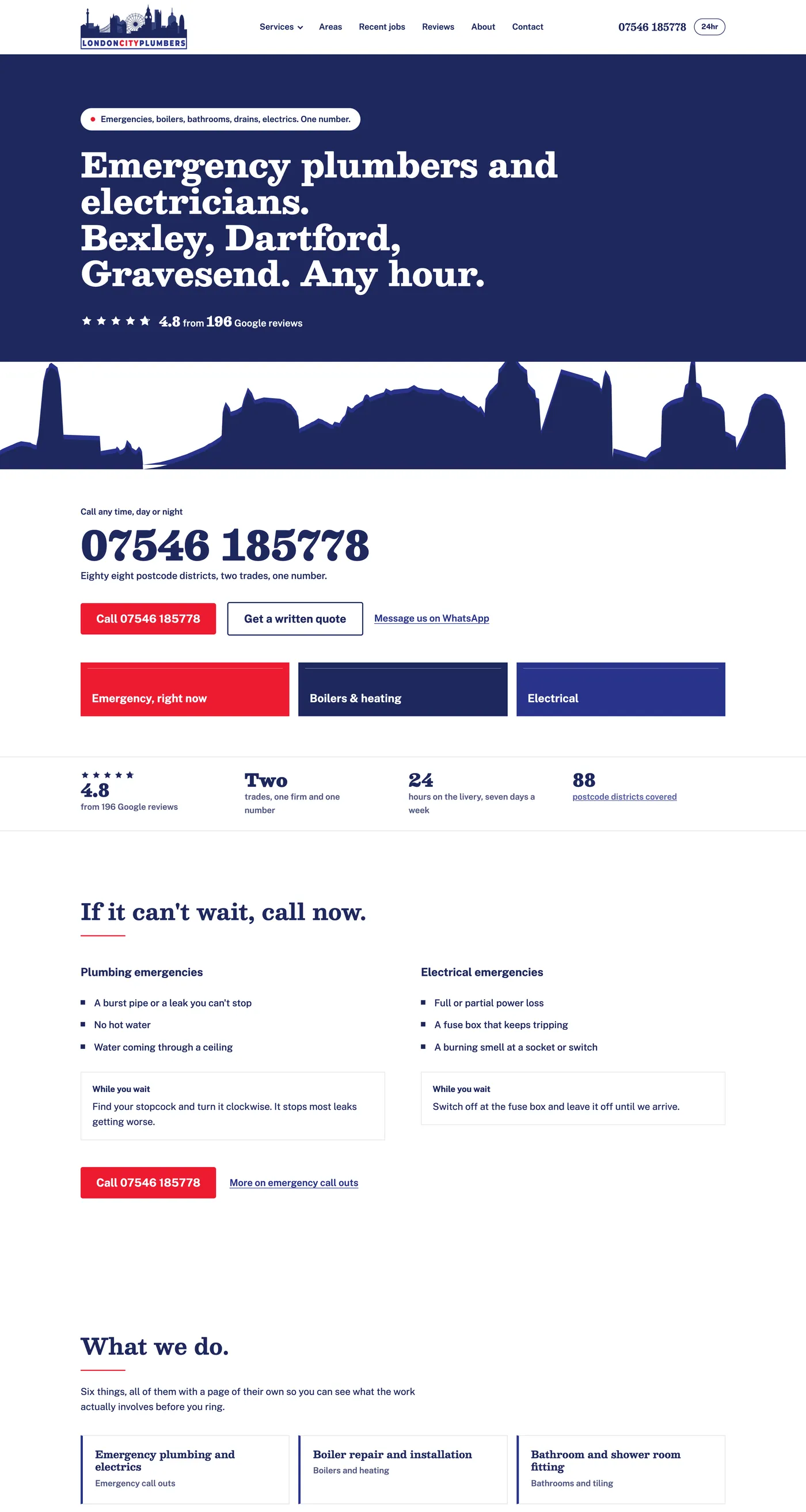
His homepage, and his pages for Bexley DA5, Dartford DA1 and Eltham SE9, as they are live. Every code has a page like them.
Farrel’s site runs to 106 pages, and every one of them had to earn its place. He answers plumbing and electrical calls across south east London and Kent, and it is the largest site I have built.
Two trades, one number
His homepage opens with Emergencies, boilers, bathrooms, drains, electrics. One number.
London City Plumbers takes plumbing work and electrical work across south east London and Kent, from Bexley, Bromley and Croydon out through Dartford and Gravesend. Somebody with a leak coming through near a socket has two problems at once, and Farrel’s selling point is that one firm deals with both on one number, which is why that is the first thing his homepage says.
Carrying two trades on one site is harder than it looks. Lean too far into the plumbing and the electrical work reads like something bolted on last year, then split them evenly across every page and the firm stops sounding like one firm. Six service pages hold that balance, so neither trade ends up as a line in the footer.
A page per district
The usual approach is one areas page carrying thirty place names in small grey type near the bottom, written for nobody in particular.
The person searching is standing in one district, usually at an awkward hour, typing the job and the name of where they are, and what they want next is a page that names their district back to them rather than a list to scan for their own town. So every postcode district he covers got a page of its own, with the Areas hub above them as the one place the whole patch is visible at once. That hub is the page to open if you would rather test this than take my word for it.
The risk at that size is the same paragraph copied down the list with the place name swapped, which a reader spots immediately and a search engine works out eventually. The rule I built to was that a district page with nothing true to say about that district did not go up. Open the Areas hub, then his page for Bexley DA5, then his emergency plumber page, and see whether they read like somebody understood the trade first.
Why that size
Farrel has his own 4.8 from more than 190 Google reviews, off his own jobs and nothing to do with me, and that rating is the reason a site this size made sense for him rather than being an expensive way of looking busy. Getting a stranger onto a district page only counts if what they read next gives them a reason to ring, so his rating sits on every page where anybody can check it against Google, and the number to ring sits beside it. A firm with no reviews behind it would get very little from the same number of pages, because every one of them would lead to the same unanswered question about whether anybody has used them before. The size of a site is set by the business rather than by me: Luke at L.C Plumbing works on his own out of Sawtry, so his site runs to 18 pages, one for each of the twelve towns he drives to and the few a customer needs besides, while Farrel answers calls across the whole of his patch, day and night, and his site is as big as the patch is. If you are wondering whether one person can build and look after something this size, this is the answer I would give you, and every page of it is open to read.
Not on this page
There is no ranking data. Positions move depending on which street the person searching is standing in, so a flattering screenshot proves little while leaving out everything underneath it, and I would sooner write that than crop a graph.
An enquiry count is not something I can hand you either. The only advertising figures on this site came out of one renovation client’s ad account, and Farrel is not that client. What is here to be judged is the build, which is the part I am answerable for.
His review
On my Google profile, where I cannot edit a word of it. Farrel left it from the Google account in the name Katrina Quinn, which is the name Google shows on it.
- Rated 5 out of 5 stars.
Has made a website for me and am extremely happy so far.
Katrina Quinn
Open it yourself
The whole thing is at londoncityplumbers.co.uk. If you do plumbing or heating yourself, there is a page on what a plumbing site has to do in the first few seconds, and the monthly work that keeps pages like these earning is written up too.
Websites for plumbers · Getting found on Google · All the work
Adamant results. Unbreakable standards.
Book a diagnosis
If your patch runs to more than a couple of towns, tell me the places you would take a job in tomorrow and I will tell you how many pages that honestly needs, which for most firms is far fewer than 88. The call is free and so is the diagnosis, or email cameron@adamantine.app.
Book a diagnosisMessage me on Facebook (opens Facebook in a new tab)