Getting found on Google
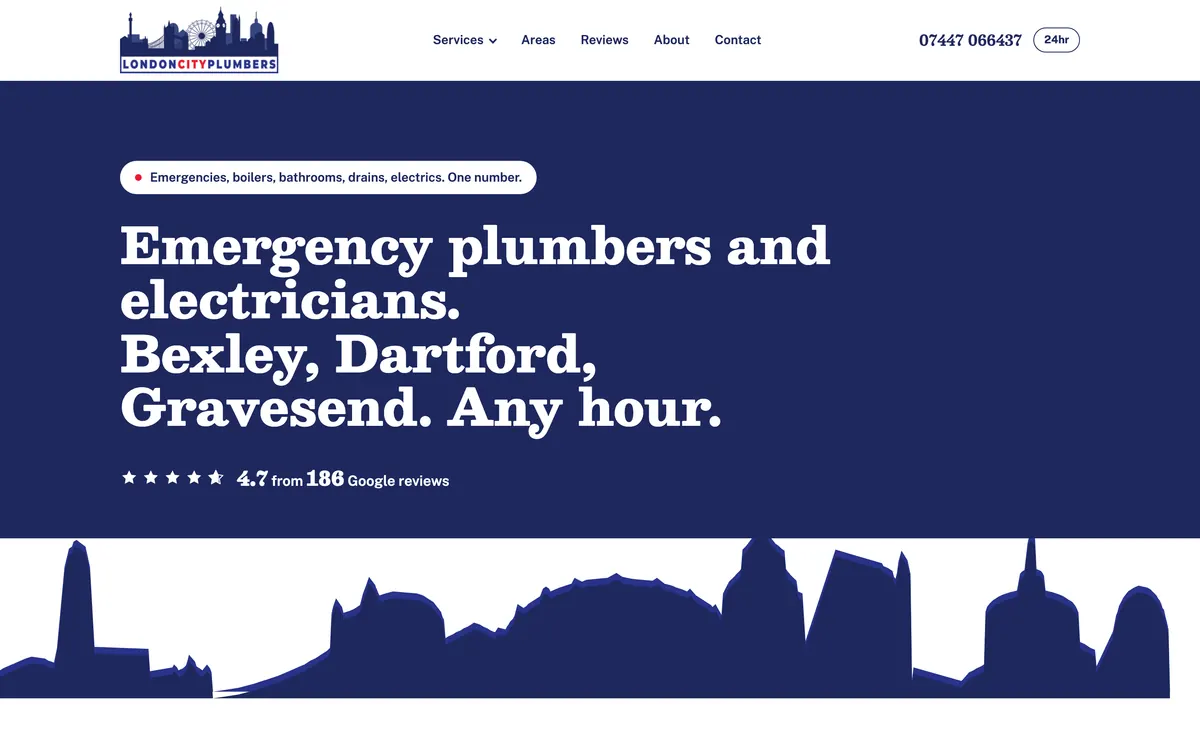
Farrel does plumbing and electrics across south east London and north west Kent, and his site carries fifty-eight postcode-district pages, six service pages and an Areas hub, because that is what covering his patch took.
Why seventy pages
Somebody in Bexley with water coming through a ceiling types a job and a place into Google. Land them on a homepage listing towns in small grey type and they are gone, so every district he works in got its own page, and the hub exists to hold them all together.
It was worth building at that size because of what he already had, his own 4.7 from 186 Google reviews. Getting a page in front of a stranger only helps if there is something worth reading behind it. It was the largest thing I had built when it went live, and Pick A Block has since gone past it at eighty-seven pages, which is my answer if you are wondering whether one person can handle something big.
A month of the work
Most of it is page work. Rewriting an area page that reads thin, adding a district that got missed, putting last week’s job onto the page for the town you did it in. Unglamorous, and the part that compounds, because the improvement stays on the page instead of stopping when the month you paid for does.
Your Google Business Profile
For a lot of local searches the profile turns up before the website does, so it gets the same monthly attention: photographs from the jobs you finished that month rather than the same handful from last year, the questions people post answered in full, and your hours and areas kept honest. Al’s site is built around one photograph of him with his van, and that sort of picture beats anything out of a stock library.
People type the job and the place
Nobody searches for quality plumbing services. They search for a boiler in Rainham, a scaffold in Maidstone, a patio in Beckenham, and the pages get named the way that sentence comes out. David’s site names Chatham, Rochester, Gillingham, Rainham and Strood outright, Charles’s covers Beckenham BR3, Chislehurst BR7, Catford SE6 and Blackheath SE3, and Luke’s carries a map of his run through Huntingdon, Peterborough, St Neots, St Ives, Ramsey and Cambridge.
Then a written report
At the end of every month you get it in writing: what I changed, which pages it was on, and what moved. If nothing moved, the report says so, because pretending is more expensive than patience.
An empty diary this week
This work is slow. It takes months before it does much, then keeps paying long after the month you paid for it, which is the whole reason it is worth doing. Ads run the opposite way round. One advertising client, a renovation firm, had thirty enquiries land inside a month, and the day his spend stops the enquiries stop with it.
So if you ring me about Google and the real problem is nothing on for next week, I will tell you to spend it on ads first and come back once the phone is moving. That is me talking you out of the monthly work, which is the wrong way round commercially and the right way round for you.
No rankings screenshot
A screenshot of a position is the easiest thing on the internet to pick and choose, since two people standing in different streets get different results for the same words. The first of these sites went live in June 2026, so the truthful answer is that none of them have been up long enough to show you a year of movement, and I would rather say so than crop a graph.
What I can hand you is the pages themselves, so open Farrel’s Areas hub and count them. Worth adding that Cody’s roofing site carries no location word anywhere, deliberately, so I do not put it forward as local search proof and neither should you.
Your towns
The towns you would take a job in tomorrow are the ones I want, along with the postcodes you would rather not drive to. I will tell you whether monthly work on your pages is worth starting or whether it should wait behind something else.